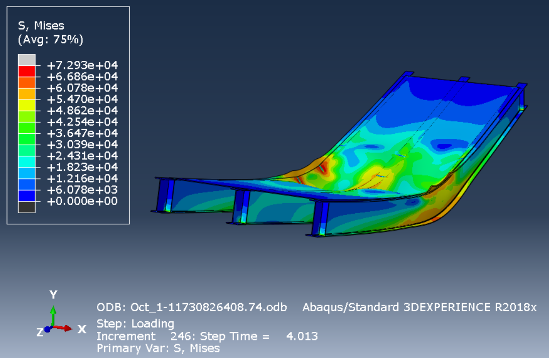
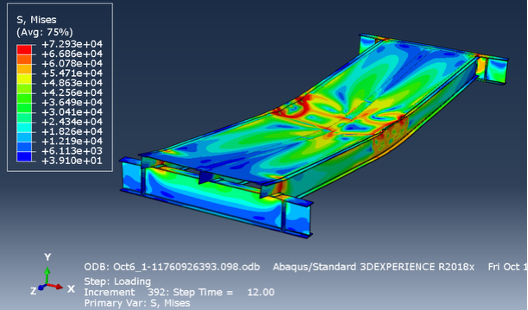
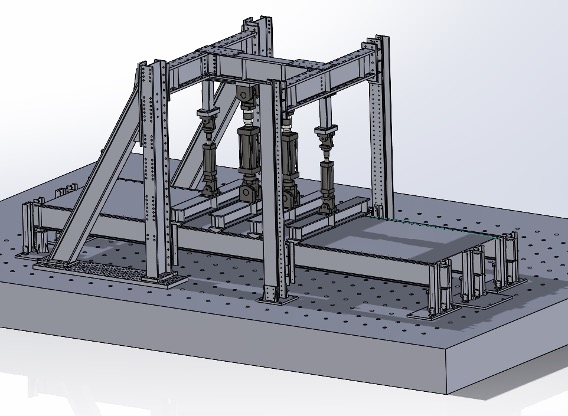
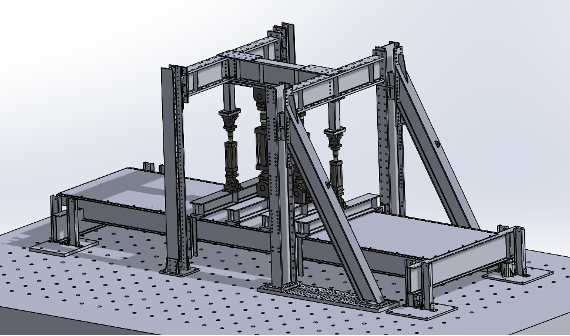
Research at Northeastern University (Ruipeng Liu, Sujit Bhandari, Jerome F. Hajjar) is focusing on the structural behavior of the FastFloor system subjected to gravity loading, including studying plate buckling, local buckling between fasteners, and composite action between the beam and the diaphragm. Finite element simulation is employed to investigate and predict potential failure modes, which are then validated through full-scale experimental testing of a FastFloor module attached to an edge beam with high-strength steel bolts and Shuriken nut assemblies. The experimental testing is conducted at the Laboratory for Structural Testing of REsilient and Sustainable Systems (STReSS Laboratory). Figures 1 and 2 represent two different specimens with four actuators applying gravity load to the specimens.
Nonlinear finite element analyses have been completed for two different test specimens, each 10 feet wide by 40 feet long. One specimen is simply supported, while the second specimen frames into a W30X108 girders using a shear tab at one end and seated connection located at the mid-height of the web at the other end. Figure 3 represents the simply supported FastFloor system after application of gravity load. Figure 4 represents the FastFloor system supported by W30X108 girders before and after application of gravity load. The FastFloor system, whose design is controlled by vibrations, exhibits significant overstrength. The plate reliably provides sufficient restraint through composite action to recover the flexural strength of the three bare steel beams, and approaches the full composite strength, although inelastic local buckling failure modes control the ultimate strength. These results will be supported by experimental testing.